
In the world of color, many factors impact the ability to reproduce good color. The most basic (and often overlooked) factor is the ability to see color correctly. The lack of this ability is called colorblindness. About 8% of the male population suffers from colorblindness, while less then 1% of females do.
There are different types of colorblindness that affect which colors cannot be perceived as different, and how limited the differentiation is. Surprisingly, many eye doctors do not administer colorblindness tests as a part of the routine eye examination.
Although we all know that the colors viewed on your computer's monitor are not accurate for print reproduction, your screen color is probably good enough to yield reasonably accurate colorblindness test results. We invite you now to test yourself for colorblindness online.
The most famous colorblindness test was created by Dr. Shinobu Ishihara of University of Tokyo. If you visit an ophthalmologist you will most likely be given some variation of this test. Click here to take the Ishihara Test.
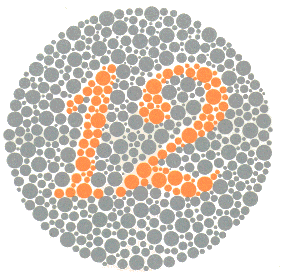
A unique and very interesting variant to most conventional colorblindness tests has been developed by Aaron Clauset of Haverford College. Unlike most tests, which require good color vision, only the colorblind can pass his tests! Click here to take the Clauset Test.
Aaron's friend and collaborator Nick Yee even takes this test a step further on his website by including a graphic that reveals one thing to the colorblind and another to those with normal vision. Click here to take the Yee test.
A highly interactive test developed by Jean Jouannic not only detects colorblindness (or Daltonism, as it is also called) but also attempts to diagnose the specific type and degree of color blindness. Click here to take the Jouannic test. This may be the most useful test on our site.
The majority of the population is not truly colorblind, yet there exists a wide variation in the ability of individuals to resolve subtle variations in color. A test developed by Diana Derval measures color acuity which varies depending upon the number of color receptor cones in an individual's eye. Click here to take the Derval Color Nuance Test.
An eye surgeon in Britain has an interesting tool with which you test how your own graphics will look to when viewed by those with various types of colorblindness. Click here to try the colorblindness simulator.
Instrument maker X-Rite, whose empire include color standards company Pantone, should know color. Click here to take the X-Rite Color Challenge. Too bad X-Rite opted to make this test more entertaining than helpful.
These tests do not constitute medical advise. If after taking these tests you believe that you may be colorblind, Copresco suggests that your next step be to find an optometrist or ophthalmologist who is comfortable diagnosing and evaluating colorblindness. Choose your eye doctor carefully; not all are skilled in this area.
Remember, colorblindness comes in varying degrees. Just because someone doesn't run stoplights doesn't mean that they won't have difficulty properly evaluating accurate color reproduction on the printed page!
Calibrate Those Monitors
Color is in the eye, and brain, of the beholder
Color Illusions and Misperceptions
Sunglasses Could Correct Color Blindness
Science and Technology Offer Hope for Colorblindness
His and Her Colors: Color Names by Gender Preference
Exploring Color for Kids, Parents and Teachers
These Skulls Look Purple and Orange. They Are Both Red
Cantigny Park offers special glasses for red-green colorblind visitors
